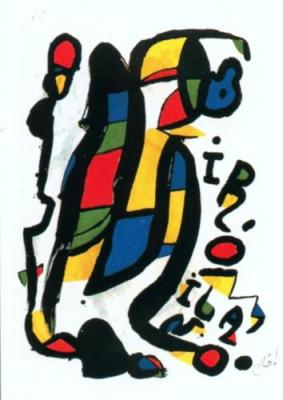
Art is a practice that allows for people to represent individualistic qualities while portraying the atmosphere of the current times. This quality of art is what makes this practice unique. It allows for both an individualistic and communal aspect to shone through in an work. These qualities give the audience at large a reason to take in and admire works of art, as these pieces are not only obviously intriguing and interesting to look at, but provide a glimpse of the culture of the actual era in time when a particular piece of art was created. That said, while there are many prominent artists in history, there is a particular artist whose work, whenever I look at, is most captivating and alluring - Joan Miro, an artist whose background perspectives blend into his artistic pieces to create both ascetically pleasing and thought provoking works for audiences abroad to enjoy and ponder.
Joan Miro was born in Barcelona, Spain and began his passion of at in this locale. Initially Miro studied both art studies and in business school, but eventually felt somewhat detached from his business studies and continued on with his artistic works. This decision led Miro to Paris, where he would eventually met Pablo Picasso and spend the rest of his career based, and more importantly eventually find his own artistic style and perspective - known as Surrealism, essentially an art movement that was based on the ideals of using concepts such as randomness and abstractness to represent the cultural movements of an era (Art Journal 2004). Miro’s work involved the use of abstract figures, colors of all spectrum, and was examples of essentially artistic technique without any rules or disciplines to follow. As stated before Miro’s use of surrealism was very much a factor in his drawings, as he sometimes relied on “spur of the moment” feelings to conjurer up a new work of art. Throughout his career Miro would involve himself with various types of art media, including paintings, drawings, sculptures, and also another type of art media known as “drawing-collages” (Art Journal 2004). Miro’s drawing-collages serve as the artistic pieces of interest for an article in a 2004 issue of Art Journal, titled “The ‘Intellectual Obscenities’ of Postcards.”
This scholarly article main argument or thesis is show how these particular works of Miro, “drawing-collages,” are representing of historical periods that are, as the 2004 Art Journal states, “densely layered and informed by Miro’s connections to Paris and Barcelona.” As described in an 2004 issue of Art Journal, Miro’s “drawing-collages” were essentially pieces of art that were completed on “easel-white paper in white, green, or dark brown.” These drawing-collages would contain inspirations from postcards and would “connect mass-produced images that were cut from advertisements, anatomical engravings, and various commercials.” In addition, as described earlier, Miro’s drawing collages was extremely abstract and complex, but as a 2004 issue of the Art Journal again points out, these collages were considered to be “violent and playful, erotic and innocent, calculated and full of chance.” This theme of incorporating opposing techniques and feelings within the collages is what made Miro’s work so dynamic and unique. Miro would eventually go on to produce over a dozen drawing collages in his artistic career. After giving general characteristics of Miro’s drawing-collages, the 2004 Art Journal focuses in on a particular drawing-collage of Miro, Joan Miro’s 1933 drawing-collage that appeared in Museum of Modern Art to help give evidence to the argument being made.
This particular drawing-collage of Miro deals with he (Miro) refers to as the “intellectual obscenities” of postcards. This 2004 issue of Art Journal looks beyond the aesthetic qualities of this particular piece of Miro and looks to discuss the actual motivators that lead to the creation of such a drawing-collage. The reasoning or purpose behind this examination is to prove the assertion that Miro’s work composed of themes that represented the cultural times of the geographic area as well as a particular time period.

The article points out that this particular piece represented Miro’s cultural background and childhood heritage he grew up with, from Barcelona and Paris. From this particular collage from the summer of 1933, Miro work represents his own opinions and perspective regarding these two international capitals, and how the overall settings and attitudes of each of these places have changed over time. The Art Journal article points out that in this collage being examined, Miro intended to look at the “patterns of exchange” between these two cities. With Miro’s primary usage of postcards and other forms of mass media/communication, particular postcards and other articles of each of these two cities were used to compare and contrast Barcelona and Paris as two cities. The most important aspect of this comparison was looking at what each city considered representing European avant-garde, or exceptional or worthy pieces of significant art forms (Art Journal 2004).
It is important to note that presence of Miro’s influence from forms of media from the two cities in this particular drawing-collage are considered to be the observations, of facts, from which the opinions, or claims are made - in this particular article, the claim being made is that Miro’s work was represented the cultural ties and separation that were present in Barcelona and Paris during the 1930s - made through the usage of the media sources from each city. Moving on, Miro found that there did exist some similarities and differences regarding the two cities as what each considered to be artistically significant and important, but the overall purpose of Miro’s work seems to hold parallel with the Art Journal’s main argument. Essentially, as the Art Journal article points out, “Miró's Drawing-Collages trace patterns of exchange between these two capitals... Miró drew lines of contact between the poetics of taste and the politics of the avant-garde” (Art Journal 2004).This examination of the artistic qualities of each city, through the usage of portraying forms of mass communication of the particular time period discussed (1930s) shows that this particular 1933 drawing-collage from Miro is intended to serve the purpose of both connecting and disassociating the cities of Paris and Barcelona, the two main locals of Joan Miro’s life.
Overall, as the 2004 Art Journal points out, Joan Miro’s pieces, drawing collages were not only amazing and striking pieces of artistic quality and ability, we can also see that Miro’s works also give the audience a perspective, from the usage of forms of mass media during the time of Miro, to give a sense of what was considered to be artistically significant and pleasing as well. So in these drawing-collages Miro produced, there are two significant that should be taken away from not only the particular 1933 art work of Miro, but his overall work as well – and that deals with Miro’s work was not only the work of artistic ability and genius but also a representation of the particular time period’s attitude and feelings towards artistic and cultural excellence.
Works Cited:
1. Mendelson, J. (2004). Joan Miró's Drawing-Collage, August 8, 1933: The "Intellectual Obscenities" of Postcards. Art Journal, 63(1), 24-37. Retrieved from Academic Search Premier database.
2. First picture: http://images.worldgallery.co.uk/i/prints/rw/lg/3/3/Joan-Miro-Milano-33422.jpg
3. Second picture: http://www.fanantique.com/en/AP0002_details.html
4. Biography source: http://www.masterworksfineart.com/inventory/3336

No comments:
Post a Comment